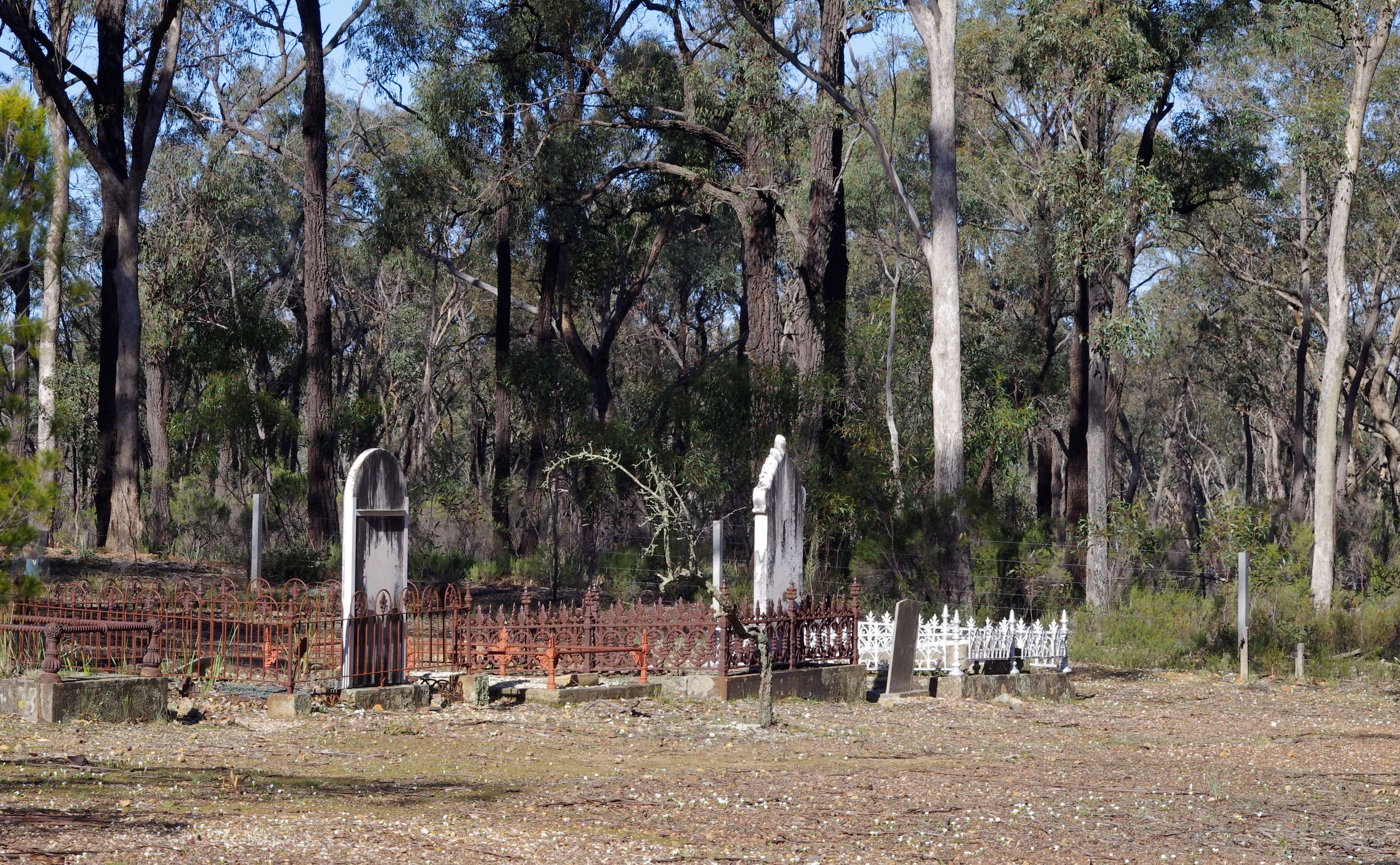
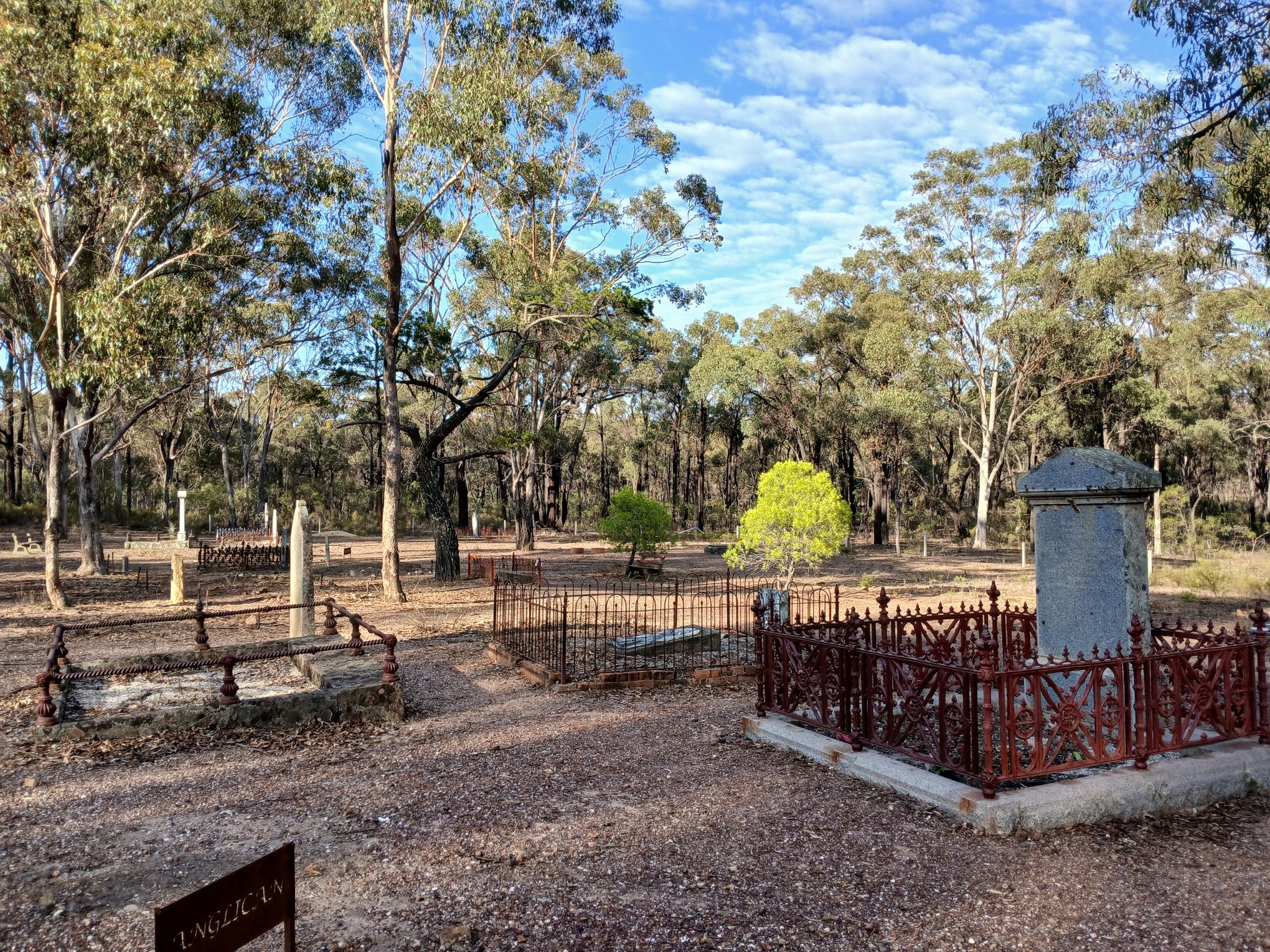
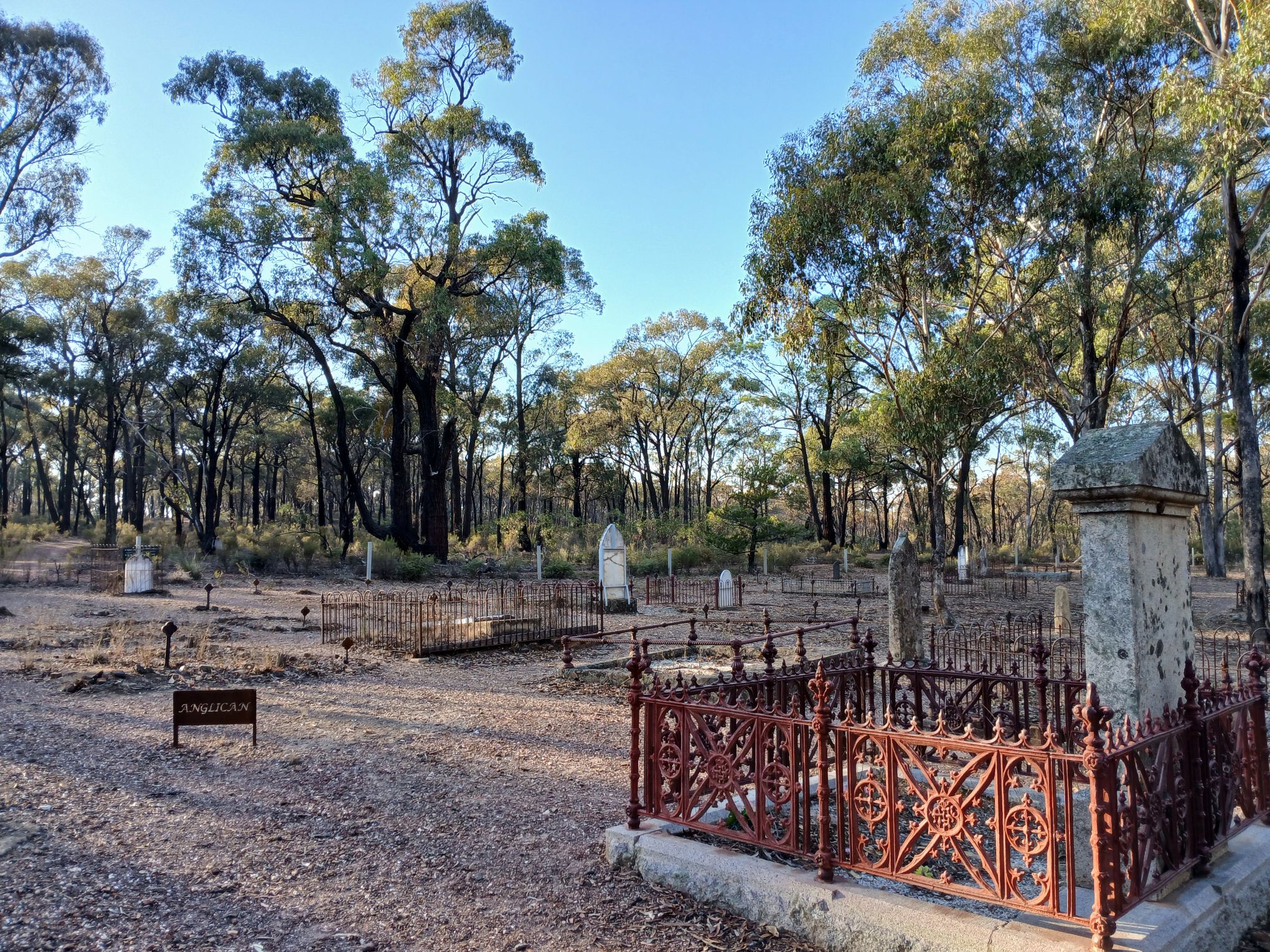
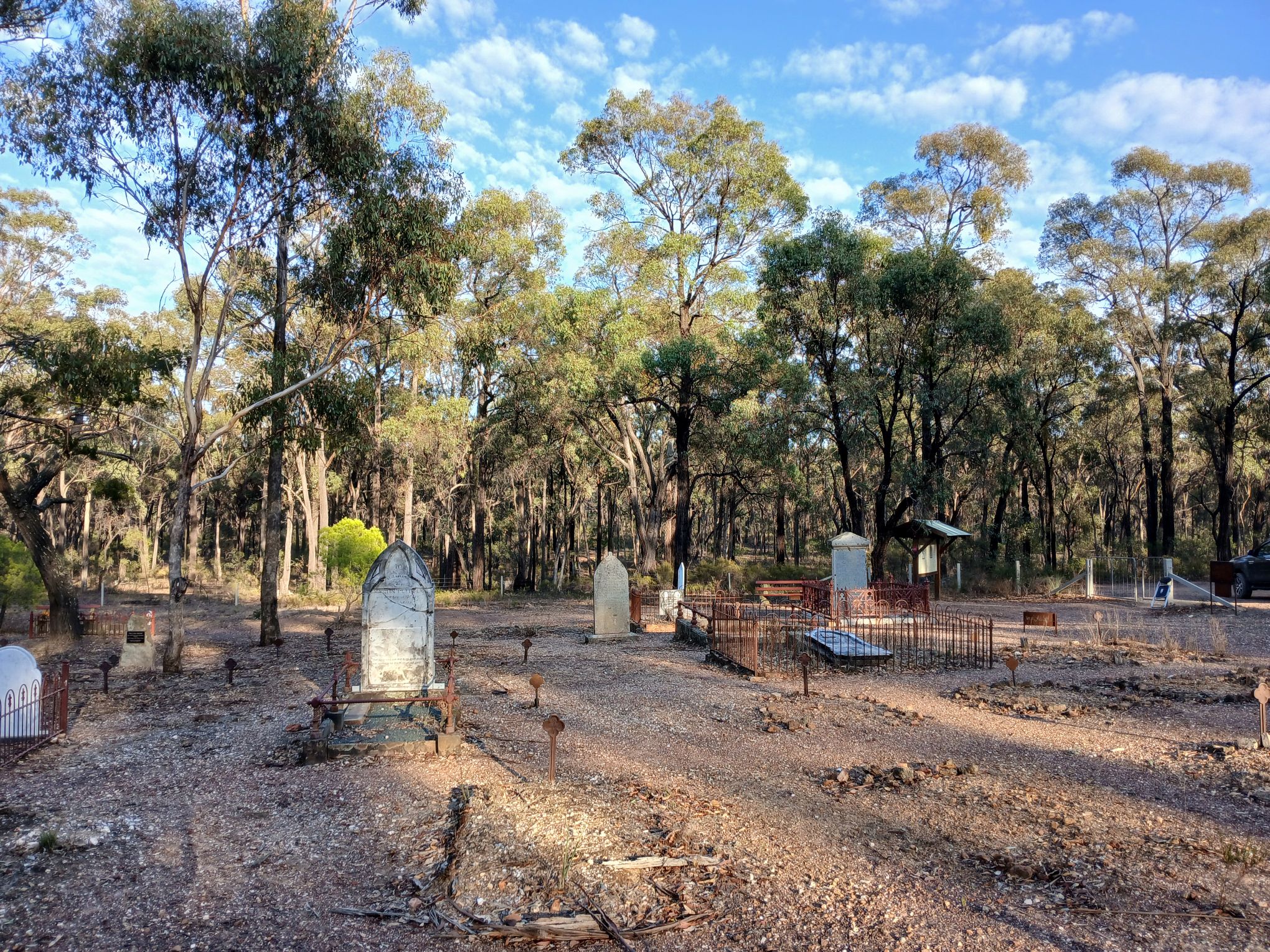
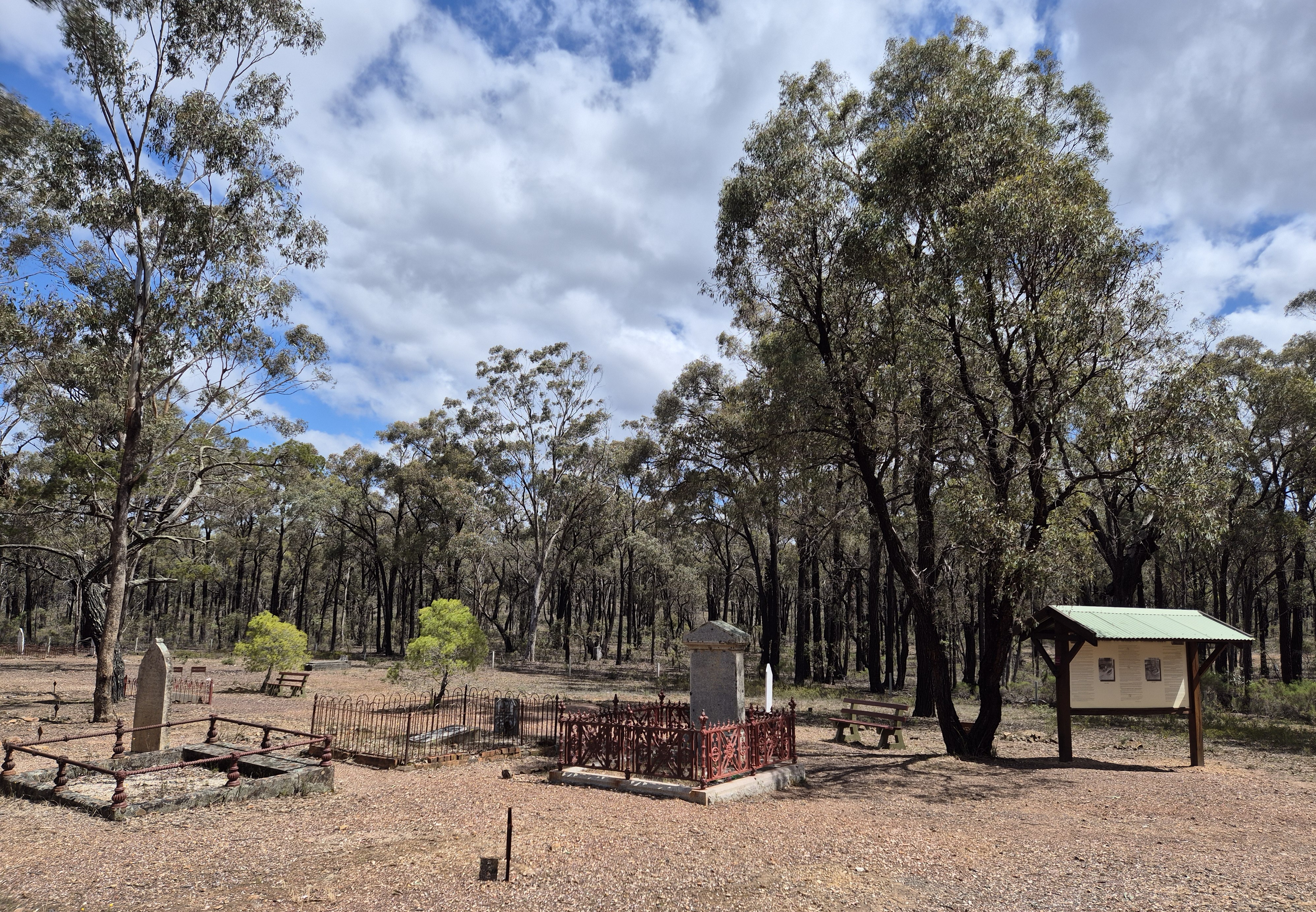
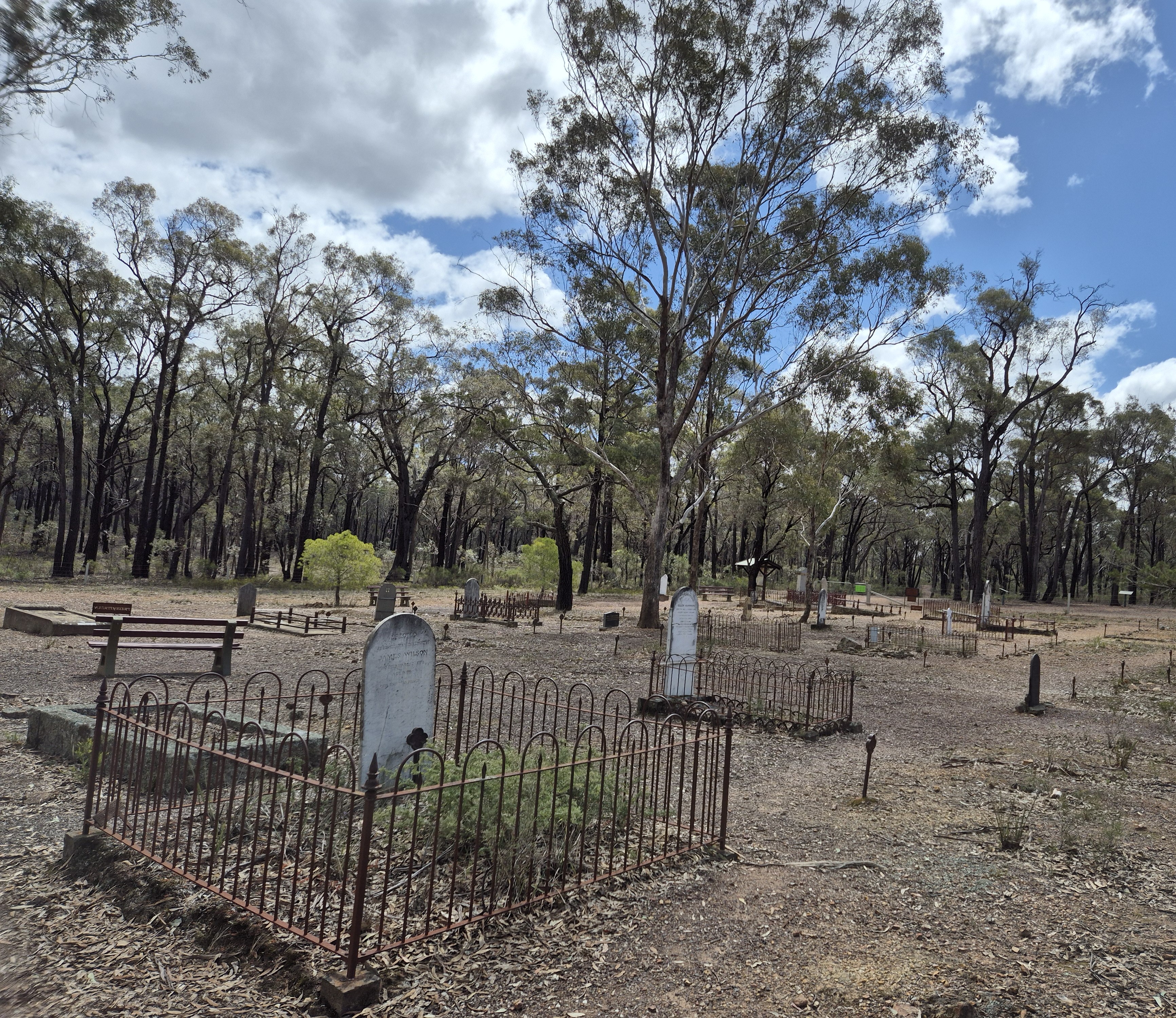
Gold was discovered in mid-1853, near what became Whroo, initially called Wet Diggings. The cemetery was not formally reserved until 21 August, 1860, with almost five acres set aside, only the one acre ever fenced and used. Some burials between 1853 and 1860 were on this land.
Was it the only site used for burials? Multiple reports in The McIvor News, The McIvor Times and Goulburn Advertiser and the Waranga Chronicle during the 1860s and 1870s provide a clue, but no proof. References are made to gold-seekers at Cemetery Gully, Cemetery Lead, Old Graveyard Lead, the old Cemetery lead, as part of the Graveyard Rush, which brought heightened activity from July to September, 1862.
But was it an old lead near the cemetery, or a gold lead near the old cemetery? If any old cemetery existed, it was informal, never officially gazetted. An early map refers to burial ground at this spot, but any official map showing any Cemetery Lead away from this location has proven elusive. Even after 1860, it is believed that some individual local burials were also completed well outside this reserve.
Walkers have reported seeing some grave-like mounds off the Whroo-Murchison Road late in the twentieth century, but were unable to find them later. Others have also searched.
In September 1860, the Government Gazette announced: Henry J. Haines, William Small, William Sellars, James Hannah, and Thomas Kittle, to be the trustees of the land set apart at Whroo as a site for a public cemetery. By May 1861, Mr Small had returned to England, replaced by Mr Francis Rennison. Each religion was expected to nominate one trustee. Fees were set for adult and child burials.
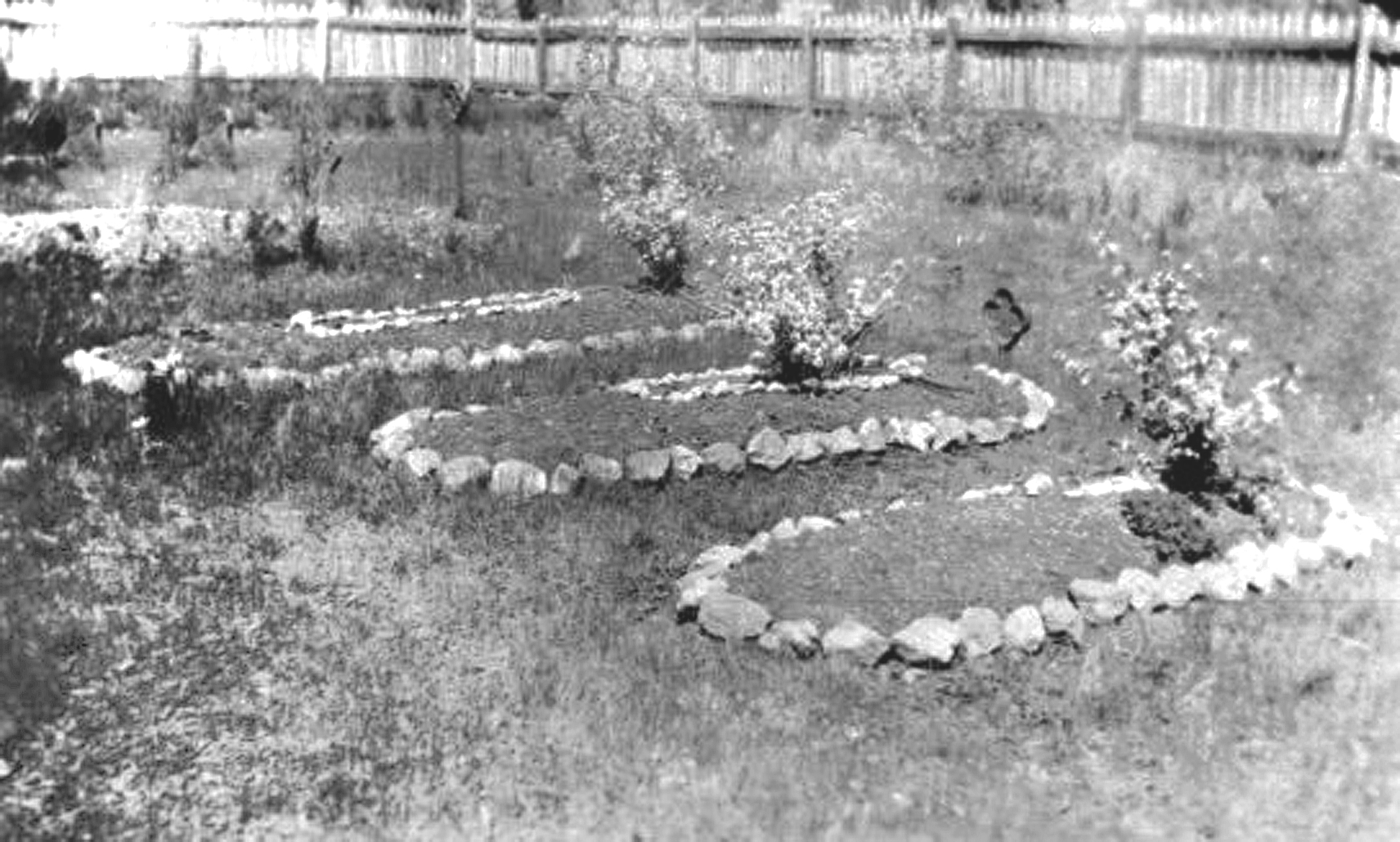
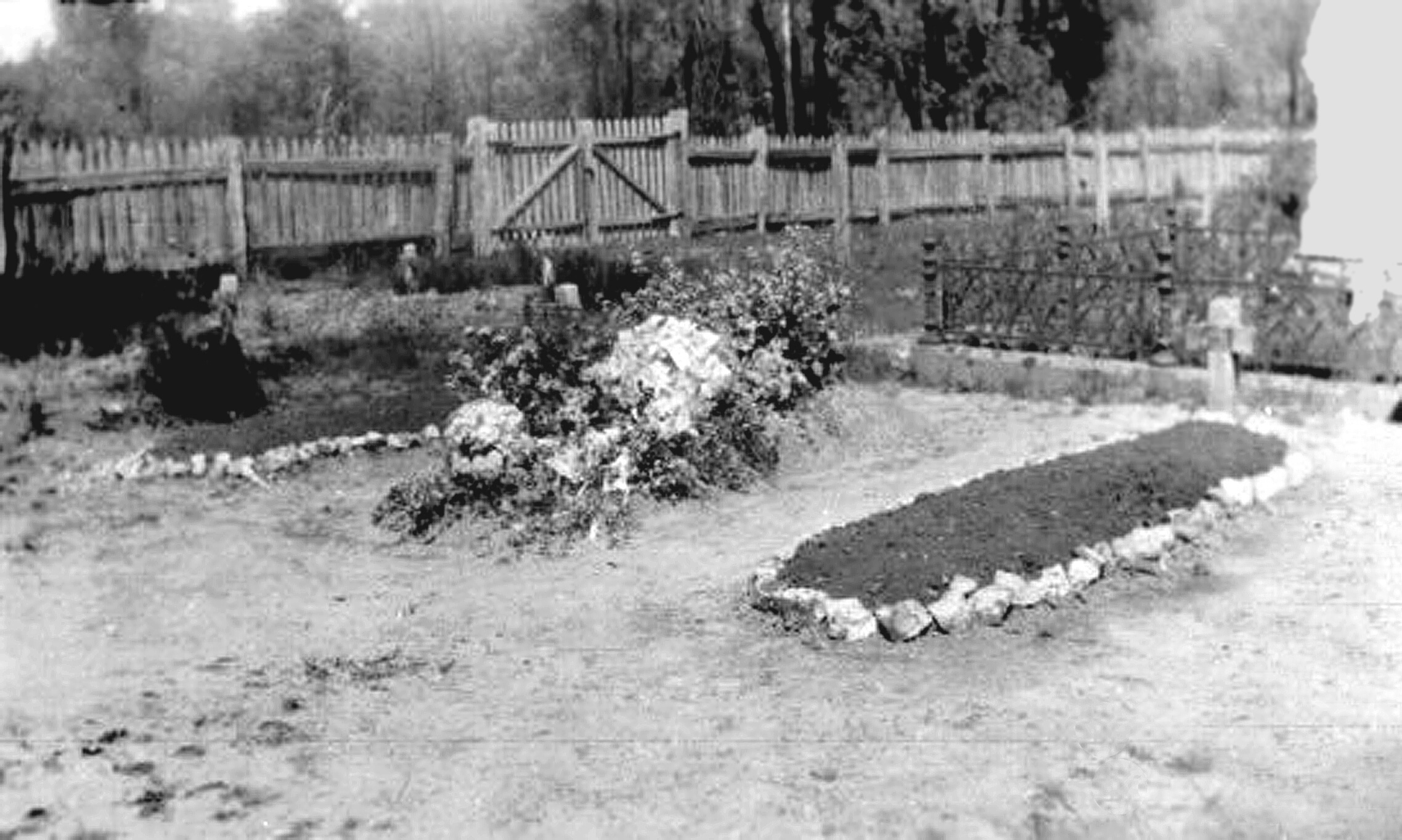
In 1862 a timber fence was erected around the single acre. Mr Freeman, of the Tooborac Nursery, presented acacia, poplar, and cork trees to improve the cemetery's appearance in June of 1866. The trees failed. Government botanist Baron Ferdinand von Mueller recommended trees suitable for the reserve in 1872. Juvenile native plants may have lacked water and attention after planting.
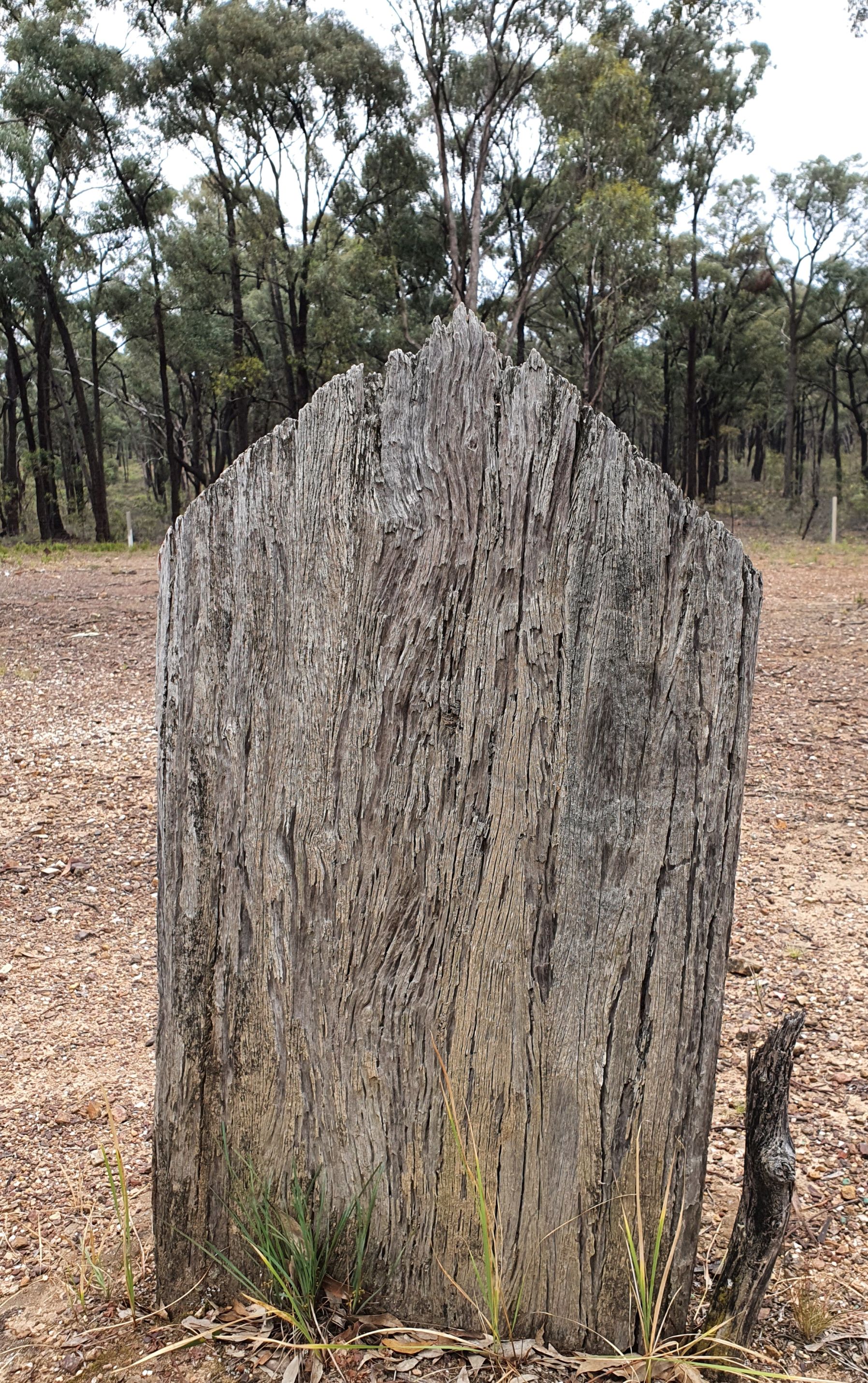
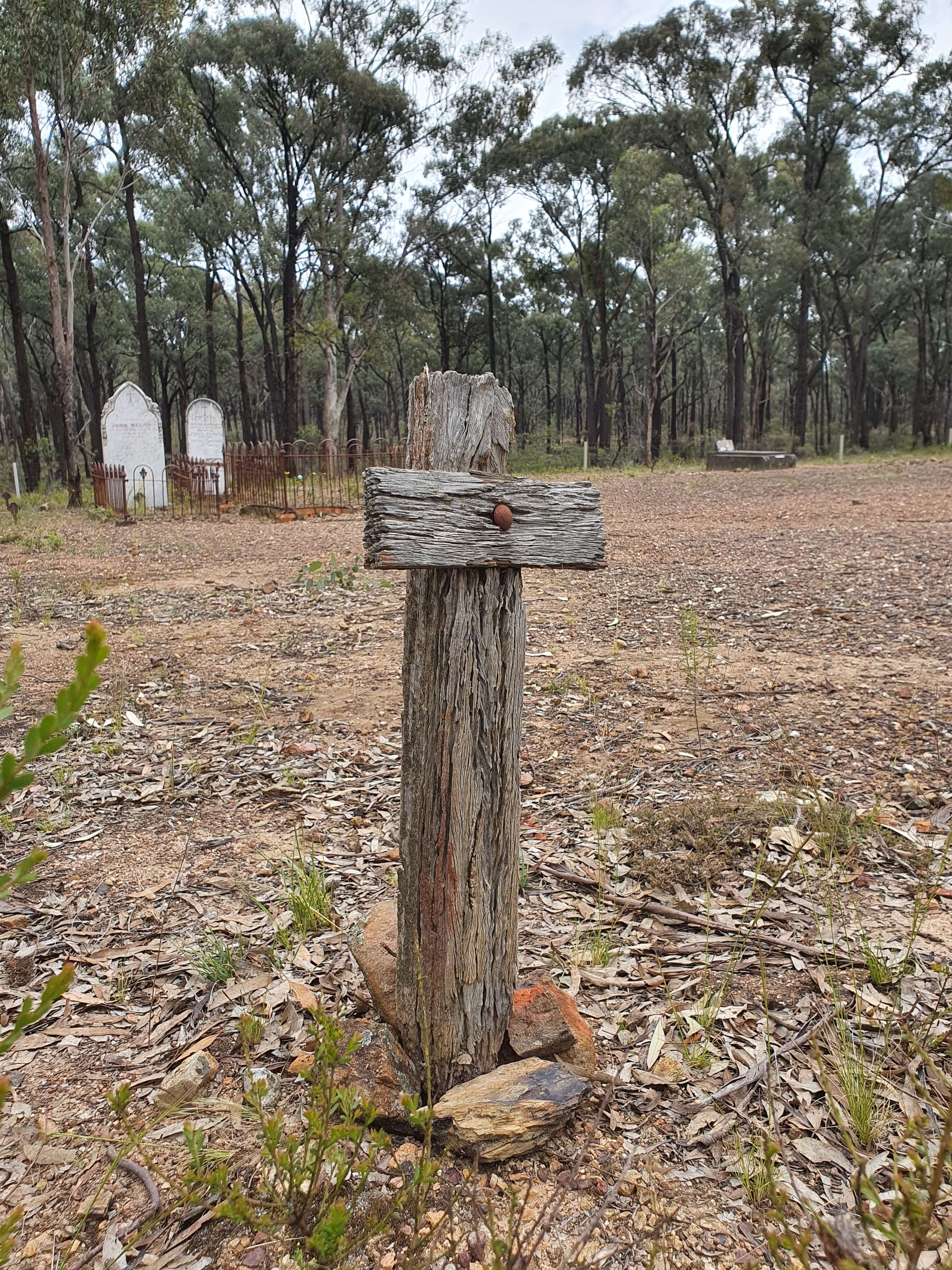
Early trustee John Lewis, of Balaclava mine fame, donated 150 numbered iron markers, known as trefoils (a three-leafed plant) in 1870. Only a few remain, without any guarantee that they are now in their correct positions. Timber tributes, markers and crosses were also displayed in the early years. Weathering and white ants were their downfall.
1887 was a grim year, burying 14 children and 8 adults. 1869 and 1875 both saw 18 burials.
Few interments arose after 1940, meaning that revenue fell. In some years there were no burials. Late last century cemetery responsibility fell to Waranga Shire, then briefly early this century to Campaspe Shire, before appointed trustees again accepted responsibility.
Here lives are commemorated, deaths are recorded, family history is linked, and memories are made tangible. However, in time no visitor will truly personally remember anyone buried here. The last official and formal funeral farewell was given to Mrs Mary LeRoy in 1971, aged 89.
The cemetery is a history of people, an enduring record of yesterday and a sanctuary of peace and tranquility today. Visitors are requested to show full respect to this place. Descendants bring reverence. Historians seek information. Our heritage is thereby enriched.
Testimonies of devotion, pride and remembrance are recorded and preserved to pay warm tribute of accomplishment and to the life, not the death, of a loved one. This place offers reflection and awareness of people gone before as a source of comfort to the living.
Our cemetery is maintained because every life is worthy of recognition. It is managed by a Trust of volunteers, with oversight by the Department of Health and Human Services Victoria, which handles the appointment of Trustees.
WHROO CEMETERY TRUST MISSION
The Whroo Cemetery Trust mission is to care for this important historical burial place. The Trust seeks to provide an environment respectful for those who are buried, interesting and safe for all visitors.
While the cemetery is closed for burial purposes, the Trust invites applications for the repair and maintenance of existing monuments, and for the creation of new plaques for placement appropriately within the reserve. The Trust may levy a modest charge for this service.
Applications may also be made for ashes to be scattered within the Cemetery grounds.
Copies of guidelines for headstone repairs and plaque placement may be obtained from the Trust secretary who is also available to receive general inquiries and donations to support the Trust mission.
As the Cemetery is a place worthy of maintenance as part of the heritage of Whroo and district, the Trust seeks to discover information about the people buried here, and to share the details with all who may be interested. All inquiries, or better still, specific information, may be directed as shown on the final frame of this website.
AMONG THE EARLIEST CONFIRMED
A prominent genealogist, Mr. Richard W. F. Hopkins, visited here in January 1956, 96 years after the cemetery's creation. He recorded headstone information. Writing then to the Health Department to ask (unsuccessfully) about early records, Mr Hopkins reported:"The cemetery, surrounded by an old and unpainted paling fence, is found in the bush, with only a track leading to it.
The earliest date found on a headstone (actually a wooden one) in the cemetery is _ April 1858 (no date stated) of an infant son (no name stated) of Wm. Small."
The register of deaths at Whroo shows the infant's name also being William Small, no age given, no parent names shown, buried in the Church of England section on 19 April, 1858, thereby aligning with the notes taken by Mr. Hopkins. So William Small junior, son of an initial trustee.
Mr Hopkins also noted William Huggins, buried in the Church of England section on 10 May 1859, aged 53, another interred before the cemetery was formally created.
Another very early burial was Mary Rae, just two days old when buried on 6 June, 1859.
Hopkins reported a timber memorial which honoured Robert Black, died 27 April 1860, 28 years. Native of Country Antrim. The deaths register has him buried on 29 April, 1860.
Carved on wood, and barely legible to Hopkins in 1956, was a tribute to Ann Hannah shown as died 28 August 1860, 6 years, daughter of James and Elizabeth Hannah. This was one week after the cemetery was gazetted.
LIST OF INTERMENTS - THE CENTRAL PLAQUE
In the centre of the reserve, a large brass plaque lists 225 adults and 193 children believed buried here. Those who prepared it acknowledge the list is not complete. Further research indicates possible or probable burials between 1853 and 1860, and some of later date.ADDITIONAL BURIALS AND CLARIFICATIONS FROM THE PLAQUE
James Curran, miner, was found dead in his bed at Whroo on Christmas Day, 1860, buried that evening after a brief magisterial inquiry, reported in The McIvor News, 4 January, 1861.August Friedrich Wilhelm (known as Frederick) Zeitz, a miner buried 9 March, 1878. This is confirmed by the Registrar of Deaths. Mr Zeitz replaces the plaque’s Oppermann listing shown for 11 March, 1878. Oppermann was shown in the Registry as a witness to the Zeitz death.
James Sharp is shown on the plaque as buried 1863. His death is registered as June 1862; newspapers report it as 1862. He is named on the Lewis tombstone, and was a brother-in-law of John Lewis.
Cicero Walter Priddeth appears in the deaths register, having died at Bailieston, aged 21 days. His name replaces the plaque's unnamed child Bredith, buried 27 October, 1882.
Mary Hannah Berry was buried 23 September, 1879, not July of that year.
Alexander McNaughton is correctly shown as buried 29 January, 1887 on the plaque. The same man is mentioned in contemporary newspapers as John McNaughton.
Mr Wilson. An old age pensioner named Wilson, residing at Whroo, died from cancer on Tuesday morning last [14 June, 1904]. The remains were interred at Whroo cemetery on Wednesday. (Rushworth Chronicle, 17 June, 1904)
John Stazel is the correct spelling for the plaque's John Hazel, interred 15 February, 1894.
William Henry White is shown buried in 1873 but the deaths register has him dying at Whroo in 1877.
Ah Hing should replace the plaque name Ah Ning on 8 July, 1874, as per the register.
Twins John and Thomas Hoskin join their older brother, also named John, 1 year, buried 23 July, 1887. The twins, aged just one day, were interred 20 March, 1888. Two death certificates were issued with consecutive numbers. The correct spelling is confirmed as Hoskin. (The plaque has two burials on 20 March, 1888. One is unnamed adult Hoskin and the other an unnamed Hoskins child buried the same day. These two plaque listings can be set aside.)
PROBABLE BURIALS NOT NAMED ON PLAQUE: GEORGE WHITE AND WILLIAM STEWART
The following people seem very likely to be buried here:On Friday last a very old resident of Sailor's Flat, near Whroo, named George White, passed away from general break-up of the system. The deceased, who was a miner, was said to be very well connected in the old country. The Rev. J. R. Walker officiated at the grave. Mr G. Anderson had charge of the funeral arrangements. (Rushworth Chronicle, 30 November, 1889)
Another old identity of the district has passed away in the person of Mr William Stewart, of the Junction Hotel, Whroo, whose death took place on Friday evening last. The funeral service was conducted by the Rev. J. Weir, B.A., with the mortuary arrangements being in the hands of Mr G. Anderson. [The article mentions his 30 years spent at Whroo.] (Rushworth Chronicle, 2 August, 1907)
Whroo cemetery records do not show a George White, or any White buried in 1889, and there is no listing in Rushworth cemetery records. William Stewart is in the same situation. Local men who spent many years at Whroo. A local minister. A local undertaker. With these officials involved, it seems most likely that both men were buried here, and not in isolated bush graves, with their names not recorded for some reason.
POSSIBLE BURIALS 1857-1858: ANNA MILLAR, WILLIAM WILSON, MARTIN HALLORAN, CATHERINE WOOD, JOHN BELL, JOHN PEARSON AND BABY MURPHY
These people may rest in this reserve, or elsewhere nearby in the Whroo area. Reported prior to 1860 as deaths at Whroo, formal funerals or burials are not mentioned.Anne or Anna Millar accidently drowned in a waterhole at Balaclava mine, as found by an inquiry on 1 June, 1857. Her brother Edward Millar was buried here in 1861, so Anna may have been buried here four years earlier, in 1857.
Death: On the 14th instant [June], William Wilson, Victoria Hotel, Whroo, Goulburn Diggings, formerly of the Commercial Inn, Dumfries, Scotland, aged 61 years.(The Argus, 26 June, 1857)
Inquiry held at Whroo, 9 December, 1857, after fall of earth killed Martin Halloran or OHalloran. Death: On the 27th ult., [January], at the Balaclava Hotel, Whroo, Goulburn Diggings, from the effects of a severe burn, Catherine Wood, late of Clapham, near London, aged 21 years. Home papers please copy. [Copies of The Argus were mailed to London newspapers, arriving several months later.] (The Argus, 2 February, 1858)
Death: On the 14th inst.[February], on Balaclava hill, Whroo, Goulburn Diggings, of an attack of paralysis, Mr. John Bell, engineer, of Dumfries-shire, Scotland, aged 54 years. (The Argus, 19 February, 1858)
Death: On the 10th inst. [August], at Whroo, Mr. John Pearson, of Wigton, Cumberland, aged 36 years. (The Argus, 20 August, 1858)
Dr. Roche, District Coroner, held an inquest on Saturday last at the Balaclava Hotel, Whroo, Waranga, on the body of a male child, who had been found in a deserted shaft on the Balaclava Hill. [Sad details follow on mother Jane or Margaret Murphy, and the death of baby Murphy.] (Bendigo Advertiser, 4 October, 1858)
The baby’s mother served two months in Rushworth gaol for concealing the birth.
LATER POSSIBLE BURIALS HERE OR NEARBY
On Wednesday last a magisterial inquiry was held here on the body of William Chamberlain who was unfortunately killed on the afternoon of Tuesday, by the falling of a drive in which he was working in Scotchmans Gully. A verdict of accidental death was returned. The deceased boy was the eldest of a large family, and the main support of his mother. (Whroo correspondent's report, The McIvor News, 8 March, 1861)
William's name is not shown in records here or for Rushworth or Murchison cemeteries. It is possible that he is buried, given the location of the magisterial inquiry.
An old miner named Henry Ashley, aged 68 years, of Whroo, was on Wednesday found in his hut to be very ill. He died before assistance could be procured. (Bendigo Advertiser, 5 November, 1901)
Not shown in recorders at Rushworth or Murchison, Mr. Ashley may be buried at Whroo, here or in the neighbouring bush. He may have been overlooked by the record-keeper.
UNKNOWN CHINESE MINERS
Chinese miners, and possibly merchants and gardeners, who lost their lives while in the Whroo district, were buried here but not all recorded. Some were clearly identified and are named on the dedicated memorial. The names of those not registered will never be known.In October 1865, the body of Ah Cong, a seller of vegetables, was found hanging from a tree between Rushworth and Whroo, after an apparent suicide. The magisterial inquiry finding was reported in The McIvor Times. The death's register is silent. Is Ah Cong buried here?